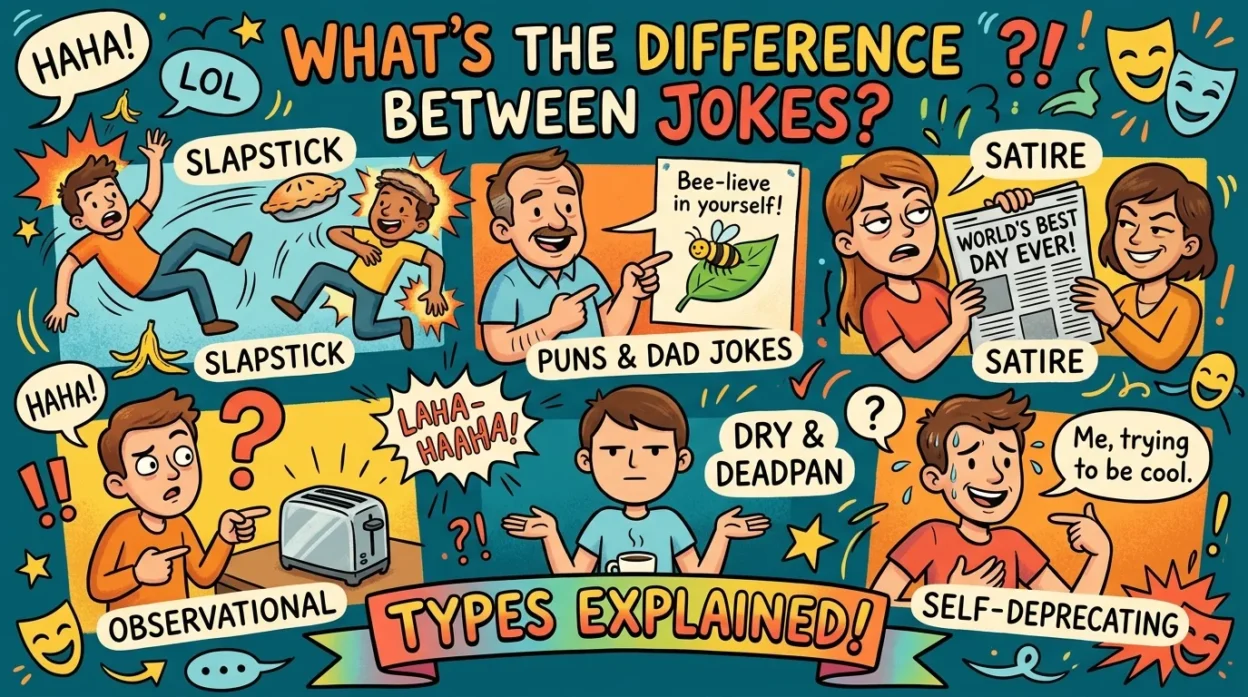
Have you ever heard someone tell a joke that made the entire room laugh, while another joke barely earned a smile? 😂 That difference is part of what makes humor so interesting. Jokes come in many forms, including clever wordplay, silly one-liners, sarcastic remarks, playful riddles, and funny stories. Each type has its own style, purpose, and audience.
Understanding what the difference between jokes is can help you recognize why certain jokes work better in particular situations. For example, a pun relies on words with multiple meanings, while a knock-knock joke follows a familiar question-and-answer pattern. Similarly, a dad joke often gets a laugh because it is so predictable that it becomes funny all over again. Some jokes are designed to surprise people, whereas others depend on timing, storytelling, or a clever observation. 🎭
This guide explores the different types of jokes, explains how they work, and shares plenty of examples to make the distinctions easy to understand. Whether you want to improve your sense of humor, entertain friends, write funnier captions, or simply understand comedy better, you will find useful explanations and playful examples here. Let’s explore what makes one joke different from another!
1. What Is the Difference Between Jokes and Humor? 🎭
Jokes and humor are closely related, but they are not exactly the same thing. A joke is a specific expression designed to create amusement, usually through a punchline, surprising ending, or clever observation. Humor, on the other hand, is the broader quality that makes something funny. It can appear in jokes, everyday conversations, facial expressions, funny situations, and even unexpected mistakes.
For instance, a person slipping into a harmless puddle might create a funny moment without anyone telling a joke. However, when someone deliberately tells a funny story about the incident, that story becomes a joke. The difference depends on how the amusement is created.
- 😂 Joke: Why did the scarecrow win an award? Because he was outstanding in his field!
- 🤭 Humor: Watching a dog tilt its head when it hears a strange sound.
- 🎤 Verbal comedy: A comedian delivering a clever punchline to an audience.
- 😆 Situational comedy: Accidentally waving back at someone who was greeting the person behind you.
- 🧠 Observational humor: Noticing that phone batteries always seem to die when you need directions.
- 🎭 Physical comedy: A performer exaggerating a stumble without getting hurt.
- 📝 Written humor: A funny caption describing a painfully relatable Monday morning.
- 🗣️ Conversational humor: Making a playful comment that turns an ordinary discussion into a funny moment.
- 🤓 Intellectual humor: A clever reference that makes people think before they laugh.
- 🫶 Friendly teasing: Lightheartedly joking about a harmless habit that everyone understands.
The main takeaway is simple: every joke aims to create amusement, but not every funny moment needs to be a joke. Humor is the larger category, while jokes are one of its most recognizable forms.
2. Puns vs. One-Liner Jokes: What’s the Difference? 🧠
Puns and one-liners can look similar because both are often short. However, they use different techniques. A pun plays with words that have multiple meanings or similar sounds. A one-liner is simply a joke delivered in one concise sentence. It may contain a pun, but it can also rely on sarcasm, irony, exaggeration, or an unexpected twist.
For example, a joke about a broken pencil uses a pun if the punchline depends on the word “pointless.” Meanwhile, a one-liner about being tired of adulthood can be funny without using any wordplay at all.
- ✏️ Pun: My broken pencil was pointless.
- 😴 One-liner: Adulthood is just saying, “Maybe tomorrow,” until tomorrow becomes a lifestyle.
- 🐟 Pun: I tried to organize a fish concert, but the scales were all over the place.
- ☕ One-liner: My coffee and I have a strong relationship, but I still need space before talking.
- 🧀 Pun: This cheese joke is looking pretty grate.
- 📱 One-liner: My phone has more social plans than I do.
- 🐝 Pun: Bees always know how to make a buzz-worthy entrance.
- 🛌 One-liner: My bed and I are committed, but my alarm keeps trying to break us up.
- 🍞 Pun: The baker had a kneady personality.
- 🧊 One-liner: I like my mornings like I like my emails: nonexistent.
Puns are particularly effective when you enjoy clever language, while one-liners are perfect for quick conversations, social media captions, and comedy performances. In short, a pun describes a wordplay technique, whereas a one-liner describes the length and delivery of a joke.
3. Dad Jokes vs. Regular Jokes: Why Are They Different? 👨👧
Dad jokes have a special place in comedy because they are often deliberately corny, predictable, and delightfully cheesy. They commonly use simple puns or obvious punchlines. Their appeal comes partly from the fact that the audience can see the joke coming but laughs anyway. Sometimes, the groan is just as important as the laugh!
Regular jokes cover a much wider range of styles. They can involve complicated stories, clever observations, sarcasm, or surprising endings. A dad joke usually keeps things simple, making it suitable for family gatherings, friendly conversations, and moments when you want a harmless laugh.
- 👨👧 Dad joke: Why don’t eggs tell jokes? They might crack up!
- 😂 Regular joke: I told my computer I needed a break, and now it keeps sending me vacation ads.
- 🧀 Dad joke: What kind of cheese is made backward? Edam.
- 🤣 Regular joke: My productivity app sent me a reminder to be productive. I dismissed it because I was busy ignoring other responsibilities.
- 🐄 Dad joke: What do you call a cow with no legs? Ground beef.
- 😅 Regular joke: My budget and I have different goals. My budget wants stability, while I want another online purchase.
- 🥚 Dad joke: How do you make an egg laugh? Tell it a yolk.
- 🤭 Regular joke: I started a fitness routine yesterday. So far, I have successfully exercised my ability to make excuses.
- 🐟 Dad joke: What do fish use to pay for things? Sand dollars.
- ☕ Regular joke: I don’t need an alarm clock. My responsibilities wake me up with increasingly aggressive reminders.
Dad jokes often work because of their simplicity and familiarity. Regular jokes, meanwhile, can explore almost any subject or style. Neither type is automatically funnier; the audience, timing, and delivery make a big difference.
4. Knock-Knock Jokes vs. Riddles 🚪
Knock-knock jokes and riddles both invite the audience to participate. However, their formats are different. A knock-knock joke follows a familiar dialogue that usually ends with a pun. A riddle presents a question or puzzle that requires the listener to think about the answer.
Knock-knock jokes are especially popular with children because the repeated pattern makes them easy to remember. Riddles can be more challenging, relying on logic, unusual interpretations, or unexpected meanings.
- 🚪 Knock-knock joke: Knock, knock. Who’s there? Lettuce. Lettuce who? Lettuce in; it’s cold outside!
- 🧩 Riddle: What has keys but cannot open locks? A piano.
- 😂 Knock-knock joke: Knock, knock. Who’s there? Boo. Boo who? Don’t cry; it’s only a joke!
- 🕵️ Riddle: What gets wetter the more it dries? A towel.
- 🍊 Knock-knock joke: Knock, knock. Who’s there? Orange. Orange who? Orange you glad we’re telling jokes?
- 💡 Riddle: What has a face and two hands but no arms or legs? A clock.
- 🐄 Knock-knock joke: Knock, knock. Who’s there? Cow says. Cow says who? No, a cow says moo!
- 🌙 Riddle: What has many stars but is not the night sky? A celebrity’s award collection.
- 🥬 Knock-knock joke: Knock, knock. Who’s there? Olive. Olive who? Olive you, and I hope you laughed!
- 📚 Riddle: What has pages but never tells its own story? A blank notebook.
The main difference is structure. Knock-knock jokes depend on a scripted exchange and a punchline, while riddles focus on solving a question. Both are useful icebreakers, classroom activities, and family entertainment.
5. Sarcasm vs. Irony: How Do These Jokes Differ? 😏
Sarcasm and irony can both create humor by contrasting what people say with what they mean or expect. However, they are not interchangeable. Sarcasm usually involves a remark that communicates criticism, disbelief, or playful teasing through an exaggerated or opposite meaning. Irony is broader and often involves a difference between expectations and reality.
For example, saying “Brilliant timing!” when someone arrives an hour late may be sarcastic. A fire station catching fire is an example of situational irony because the event contradicts what people would normally expect.
- 😏 Sarcasm: “Oh, fantastic! Another meeting that could have been an email.”
- 😂 Irony: A driving instructor gets a parking ticket while teaching someone how to park.
- 🙄 Sarcasm: “I absolutely love waiting in line for forty minutes.”
- 🤭 Irony: A weather app predicts sunshine just as a sudden rainstorm begins.
- 📱 Sarcasm: “My phone battery lasting two hours is truly a technological miracle.”
- ☔ Irony: Someone buys an expensive umbrella and forgets it on the first rainy day.
- 😆 Sarcasm: “You’re only five minutes late. I barely had time to age.”
- 🎂 Irony: A baker forgets the birthday cake for their own birthday party.
- 🧹 Sarcasm: “Your room is so tidy that an archaeologist could discover three civilizations in it.”
- 🔋 Irony: A power-saving device stops working during a power outage.
Sarcasm can be funny among friends who understand one another’s tone, but it may sound rude when the relationship is unfamiliar. Irony can create humor without directly mocking anyone. Therefore, context and delivery matter just as much as the words themselves.
6. Dry Humor vs. Slapstick Comedy 🤣
Dry humor delivers funny observations with a serious, calm, or emotionless expression. The speaker often acts as though the joke is an ordinary statement. Slapstick comedy takes the opposite approach: it uses exaggerated physical actions, harmless mishaps, and dramatic reactions to make people laugh.
Dry humor is common in witty conversations, understated comedy, and deadpan performances. Slapstick, meanwhile, is easy to recognize in cartoons, silent films, and physical comedy routines.
- 😐 Dry humor: “I have a lot of patience. I just prefer not to use it.”
- 🤸 Slapstick: A cartoon character runs around a corner so quickly that their feet keep moving after their body stops.
- 🥱 Dry humor: “My morning routine is impressively consistent. I disappoint myself at exactly the same time every day.”
- 😂 Slapstick: A performer tries to sit on a chair that someone has moved, then reacts with exaggerated surprise.
- 🧠 Dry humor: “I love making decisions. Regretting them is my favorite follow-up activity.”
- 🎭 Slapstick: A character attempts to carry too many boxes and disappears behind the stack.
- ☕ Dry humor: “I don’t procrastinate. I simply allow tasks to develop suspense.”
- 🐧 Slapstick: A cartoon penguin slides across the ice and spins in an unexpected circle.
- 📅 Dry humor: “My calendar is full of opportunities to be busy doing nothing.”
- 🤭 Slapstick: Someone tries to catch a falling hat and accidentally tosses it even farther away.
Dry humor relies on wording, subtlety, and delivery, while slapstick depends on visible action. Both can be effective, but they appeal to different tastes. Some people love a quiet, clever remark, while others prefer a dramatic physical gag.
7. Clean Jokes vs. Dark Humor 🌓
Clean jokes are designed to entertain without relying on explicit language, graphic details, or particularly sensitive subjects. They are often appropriate for family gatherings, school activities, workplace conversations, and mixed-age audiences.
Dark humor approaches uncomfortable subjects through comedy. Depending on the joke, it may touch on misfortune, fear, or the absurd side of difficult experiences. Its acceptability depends heavily on context, the audience, and the subject being discussed. A joke that feels harmless among close friends may be upsetting in another setting.
- 😊 Clean joke: Why did the bicycle fall over? Because it was two-tired!
- 🖤 Dark humor: My to-do list has been waiting so long that it deserves its own historical documentary.
- 🐸 Clean joke: What do frogs order at restaurants? French flies.
- 🌑 Dark humor: My backup plan needs a backup plan, and both have requested a vacation.
- 🍌 Clean joke: Why did the banana visit the doctor? It wasn’t peeling well.
- 😬 Dark humor: My future looks bright, according to the person trying to sell me expensive sunglasses.
- 🐝 Clean joke: What is a bee’s favorite hairstyle? A buzz cut.
- 🕰️ Dark humor: My deadlines keep approaching like they have a personal grudge against me.
- 🍕 Clean joke: Why did the pizza maker get promoted? Because they were on a roll.
- 📉 Dark humor: My life has excellent plot twists, but I’d like to speak to the editor.
The difference is not simply that one type is funny and the other is serious. Clean humor generally aims for broad accessibility, whereas dark humor draws on uncomfortable contrasts. Good judgment means considering who is listening and avoiding jokes that target vulnerable people or trivialize someone’s real suffering.
8. Observational Jokes vs. Storytelling Jokes 👀
Observational jokes turn ordinary experiences into comedy. They often begin with something familiar, such as shopping, commuting, using technology, or trying to get enough sleep. The punchline highlights an unexpected truth that people recognize immediately.
Storytelling jokes are longer and develop through a sequence of events. They usually introduce a situation, build anticipation, and deliver a punchline at the end. While observational jokes can be quick, storytelling jokes depend on pacing and carefully chosen details.
- 👀 Observational joke: Why does the refrigerator become fascinating the moment you decide you’re not hungry?
- 🛒 Observational joke: Shopping for three items somehow requires a receipt longer than a restaurant menu.
- 📱 Observational joke: We unlock our phones to check the time, then forget why we picked them up.
- 😴 Observational joke: Weekends feel shorter because Monday apparently starts preparing on Sunday evening.
- 🧳 Storytelling joke: I packed for a two-day trip like I was moving abroad. By the end, my suitcase weighed more than my plans.
- 🐕 Storytelling joke: I taught my dog to fetch the newspaper. Now he brings me every paper in the house, including the shopping list.
- 🍰 Storytelling joke: I baked a cake for my friends. It looked so unusual that everyone asked whether it was a cake or an architectural experiment.
- 🎤 Storytelling joke: I practiced a speech for an hour, walked onto the stage, and forgot my opening line. Fortunately, my nervous smile delivered a full performance.
- ☕ Observational joke: Coffee shops are places where people pay money to sit somewhere else and use the same laptop.
- 🎁 Storytelling joke: I wrapped a gift so carefully that nobody could open it. The present was a book about patience, which felt increasingly appropriate.
Observational humor is useful for social media posts, casual conversations, and relatable captions. Storytelling humor works well when you have time to build a scene and surprise your audience. The best approach depends on how much attention you have and how quickly you want the laugh to arrive.
9. Cute Jokes vs. Flirty Jokes 💕
Cute jokes create a warm, cheerful feeling without necessarily suggesting romance. They often involve animals, adorable misunderstandings, or gentle wordplay. Flirty jokes, however, are designed to express romantic interest through playful compliments, teasing, or charming questions.
The difference lies in the intention behind the joke. A cute joke can make anyone smile, while a flirty joke usually invites a little romantic chemistry. Nevertheless, flirting works best when both people feel comfortable and welcome the interaction.
- 🐱 Cute joke: Why did the kitten bring a blanket? It wanted to have a purr-fect nap.
- 💕 Flirty joke: Are you a notification? Because seeing you makes my whole day better.
- 🐼 Cute joke: What do pandas call their favorite snack? A little bamboo-nanza.
- 😉 Flirty joke: Is your smile always this distracting, or am I getting special treatment?
- 🐧 Cute joke: Why did the penguin bring a suitcase? It was ready for an ice-cation.
- 🥰 Flirty joke: I had a clever opening line ready, but then you smiled and deleted my entire script.
- 🐻 Cute joke: What did the teddy bear say at bedtime? I’m stuffed, so goodnight.
- 😏 Flirty joke: Are we having a staring contest, or should I admit that I got distracted first?
- 🌼 Cute joke: Why did the flower bring a friend? It wanted someone to grow with.
- 💖 Flirty joke: If good conversations were dates, I think we’d be planning our second one already.
Cute jokes are ideal for friends, family, and lighthearted messages. Flirty jokes work better when there is mutual interest. In either case, a natural delivery is more appealing than a line that feels forced or overly rehearsed.
10. Short Jokes vs. Long Jokes ⏱️
Short jokes deliver amusement quickly. They might consist of a single sentence, a quick pun, or a brief question-and-answer exchange. Long jokes take more time because they develop characters, describe events, or build suspense before revealing the punchline.
Neither length guarantees success. A short joke can fail if its wording is unclear, while a long joke can lose its audience if the setup takes too long. The key is to make every word contribute to the payoff.
- ⚡ Short joke: I used to hate facial hair, but then it grew on me.
- 😂 Short joke: I’m reading a book about anti-gravity. It’s impossible to put down.
- 🧀 Short joke: I told a cheese joke, but it was too mature.
- 🐄 Short joke: The cow started a podcast. It had a lot of moo-ving stories.
- 📖 Long joke: A man walks into a library and asks for a book about turtles. The librarian asks whether he wants fiction or nonfiction. He replies, “Nonfiction. I need to learn how to stop taking everything so slowly.”
- ☕ Long joke: A customer tells a barista that their coffee tastes like mud. The barista apologizes and asks whether they’d prefer another drink. The customer says, “No, thanks. I ordered it black, and I just wanted to confirm that the beans have been through a difficult time.”
- 🕰️ Short joke: My watch is broken. I guess it’s time to replace it.
- 🛍️ Short joke: I went shopping for confidence. The store said it was out of stock.
- 🎂 Long joke: A baker enters a cake competition with an enormous creation. The judges ask what inspired the design. He says, “My rent went up, so I needed something that could support the weight of my financial decisions.”
- 🧳 Long joke: A traveler packs everything for a weekend trip except their toothbrush. At the hotel, they ask reception for one and explain that they always forget something. The receptionist replies, “At least you remembered the suitcase this time.”
Short jokes are useful for quick laughs and captions. Long jokes suit social gatherings, comedy routines, and situations where listeners are willing to follow a story. Choose the length that fits the moment rather than stretching a simple idea unnecessarily.
11. Wordplay Jokes vs. Intellectual Jokes 🤓
Wordplay jokes depend on language. They may use double meanings, similar sounds, unusual expressions, or familiar phrases in unexpected ways. Intellectual jokes often depend on knowledge, reasoning, logic, or a reference that the audience must recognize.
These categories can overlap. A sophisticated joke may contain a pun, and a simple wordplay joke may require surprisingly quick thinking. The main distinction is the source of the humor: the language itself or the knowledge and reasoning behind it.
- 📚 Wordplay: The librarian was booked all afternoon.
- 🧮 Intellectual joke: Why was the equal sign so humble? It knew it wasn’t less than or greater than anyone else.
- 🥖 Wordplay: The baker rose to the occasion.
- 🧪 Intellectual joke: Two chemists walk into a bar. One says, “I’ll have H₂O.” The other says, “I’ll have H₂O too.” The second chemist’s drink order is misunderstood as H₂O₂, a different chemical compound.
- 🧹 Wordplay: The janitor’s story swept everyone away.
- 🌌 Intellectual joke: An astronomer tells a friend that their career is going well because their prospects are looking up.
- 🎹 Wordplay: The piano player had the right keys to success.
- 📐 Intellectual joke: A geometry teacher never argues without making a point.
- 🍃 Wordplay: The gardener’s business is growing on everyone.
- 💻 Intellectual joke: A programmer’s idea of a balanced diet is having equal amounts of bytes and bites.
Wordplay is especially accessible when the audience understands the language. Intellectual humor can be more rewarding for people who enjoy puzzles, science, mathematics, or cultural references. However, a good joke should still offer a clear payoff instead of making the listener work too hard.
12. Friendly Teasing vs. Insult Jokes 🤝
Friendly teasing uses humor to strengthen relationships. It usually targets harmless habits, familiar situations, or small quirks that the people involved can comfortably laugh about. Insult jokes, by contrast, focus on making someone the target of criticism or ridicule.
The distinction depends on context, intention, and impact. Friends may enjoy teasing one another about always being late, for example. However, jokes about someone’s appearance, painful experiences, or personal insecurities can hurt even when the speaker claims to be joking.
- 😄 Friendly teasing: You’re not late; you just enjoy making your entrance memorable.
- 🤭 Friendly teasing: Your cooking has one special ingredient: the smoke alarm’s attention.
- 😂 Friendly teasing: You pack for a weekend like the weather forecast includes every season.
- 🧦 Friendly teasing: Your laundry chair has officially become a furniture collection.
- 😅 Friendly teasing: You take so long choosing a movie that the credits might start before you decide.
- 🎮 Friendly teasing: Your gaming skills are impressive, especially your ability to blame the controller.
- 📱 Friendly teasing: You reply so slowly that your messages qualify as historical documents.
- 🍕 Friendly teasing: You say you’re sharing the pizza, but your slices seem to have exclusive ownership.
- 💤 Friendly teasing: Your snooze button knows more about your schedule than your calendar does.
- 🛍️ Friendly teasing: Your shopping cart has a stronger sense of adventure than your travel plans.
Good teasing makes everyone feel included. If the other person looks uncomfortable, changes the subject, or asks you to stop, respect that response. Humor should bring people together, not create an excuse to embarrass them.
13. Why Do Different People Find Different Jokes Funny? 🧠
People do not share exactly the same sense of humor. Their preferences can be influenced by age, culture, language, personality, experiences, and the company they keep. Someone who loves clever wordplay might find a simple pun hilarious, while another person may prefer storytelling or absurd comedy.
Timing also matters. A joke that works among close friends might feel awkward in a formal meeting. Similarly, a cultural reference can be hilarious to people who recognize it but confusing to everyone else. Understanding your audience helps you choose jokes that are more likely to land well.
- 😂 Fans of silly humor: Enjoy ridiculous situations and unexpected nonsense.
- 🤓 Fans of intellectual humor: Prefer clever logic, puzzles, and references.
- 🧀 Fans of puns: Love double meanings and playful language.
- 🎭 Fans of storytelling: Enjoy suspense, characters, and satisfying punchlines.
- 😏 Fans of sarcasm: Appreciate sharp observations and dry delivery.
- 🐶 Fans of wholesome humor: Prefer friendly jokes about animals, family, and everyday life.
- 🖤 Fans of dark humor: May enjoy comedy that explores uncomfortable or absurd situations.
- 📱 Social media users: Often enjoy relatable jokes, memes, and short captions.
- 🎤 Comedy fans: May appreciate timing, performance, and audience interaction.
- 🫶 People who enjoy shared humor: Often laugh hardest at jokes connected to memories or experiences they share with friends.
There is no single type of joke that everyone must enjoy. Instead, pay attention to the situation and the audience. A flexible sense of humor makes conversations easier and helps you recognize funny moments in different settings.
14. How to Choose the Right Type of Joke for Every Situation 🎯
Knowing the difference between jokes becomes especially useful when you want to make someone laugh without creating an awkward moment. The best choice depends on your relationship with the audience, the setting, and the mood. A quick pun might work perfectly in a casual message, while a longer story might suit a relaxed dinner with friends.
When in doubt, start with gentle, relatable humor. You can always adjust your style after noticing how people respond. Most importantly, remember that humor is a form of communication, not a competition to deliver the cleverest punchline.
- 📱 For text messages: Use short jokes, simple puns, or relatable one-liners.
- 🥳 At parties: Try light observational humor or easy group-friendly jokes.
- 🏫 In classrooms: Choose clean jokes and riddles that encourage participation.
- 💼 At work: Use gentle, inclusive humor that does not undermine colleagues.
- 💕 On a date: Try cute or lightly flirty jokes when the other person seems comfortable.
- 👨👩👧 With family: Dad jokes and harmless knock-knock jokes are reliable options.
- 🎤 During a presentation: Use a brief, relevant joke rather than a long story that distracts from the topic.
- 📸 For Instagram captions: Choose a memorable pun or a funny observation about the photo.
- 🧩 For a game night: Use riddles and clever question-and-answer jokes.
- 🫶 During a difficult conversation: Be thoughtful about timing and avoid using humor to dismiss someone’s feelings.
A well-chosen joke can make an interaction more enjoyable, but forcing humor into every moment can have the opposite effect. Sometimes, listening and responding naturally is funnier than preparing a punchline in advance.
Frequently Asked Questions About the Difference Between Jokes ❓
1. What is the main difference between jokes?
The main difference lies in how each joke creates amusement. Some rely on wordplay, while others use surprise, sarcasm, storytelling, exaggeration, or physical actions. Their structures and intended audiences can also vary.
2. What is the difference between a joke and a pun?
A joke is a broad category of humorous expression. A pun is a specific form of wordplay that uses multiple meanings or similar-sounding words. For example, “My broken pencil was pointless” is a pun because the punchline depends on the meaning of “pointless.”
3. What is the difference between a pun and a one-liner?
A pun relies on wordplay, whereas a one-liner is a joke delivered in one concise line. A one-liner can contain a pun, but it can also use sarcasm, irony, or an unexpected observation.
4. Why are dad jokes different from other jokes?
Dad jokes are usually simple, predictable, and intentionally cheesy. They often feature obvious puns or familiar punchlines. Their charm comes from their harmless silliness and the groans they produce. 😂
5. What is the difference between sarcasm and irony?
Sarcasm usually communicates criticism or teasing through a remark whose intended meaning differs from its literal wording. Irony is broader and includes situations where reality contrasts with expectations. Sarcasm can be ironic, but not every ironic situation is sarcastic.
6. Are dark jokes and offensive jokes the same thing?
No. Dark humor explores uncomfortable or difficult subjects, while offensive humor is humor that insults, harms, or alienates people. Dark humor is not automatically offensive, although a particular joke can be both. Context and audience matter.
7. Which type of joke is best for making people laugh?
There is no universal winner. Puns work well for quick wordplay, observational jokes connect with shared experiences, and storytelling jokes build anticipation. Choose a style that suits your audience and the situation.
8. How can I become better at telling jokes?
Start with short, relatable jokes and practice delivering them naturally. Pay attention to timing, avoid explaining the punchline, and notice how people respond. Most importantly, choose humor that fits the moment and makes others feel comfortable. 🎯
Conclusion: Understanding What the Difference Between Jokes Really Means 🎉
Understanding what the difference between jokes is comes down to recognizing the techniques, structures, and intentions behind different forms of humor. Puns play with language, one-liners deliver quick punchlines, dad jokes embrace cheesiness, riddles challenge the mind, and storytelling jokes build toward a satisfying ending. Meanwhile, sarcasm, irony, dry humor, slapstick, and observational comedy each create amusement in their own way.
The best joke is not necessarily the cleverest or longest one. Instead, it is the joke that suits the audience, fits the situation, and brings people together. 😂 Experiment with different styles, notice what makes your friends laugh, and keep your humor considerate. Once you understand these differences, you can enjoy comedy more deeply and become more confident about sharing a laugh wherever you go.

Jake Mitchell is a humor writer and wordplay enthusiast who specializes in pickup lines, puns, jokes, and witty one-liners. He enjoys creating entertaining content that helps readers break the ice, spark conversations, and share a laugh. Through PickupStorm, Jake curates fun, creative, and engaging humor for readers who appreciate clever wordplay and lighthearted entertainment.