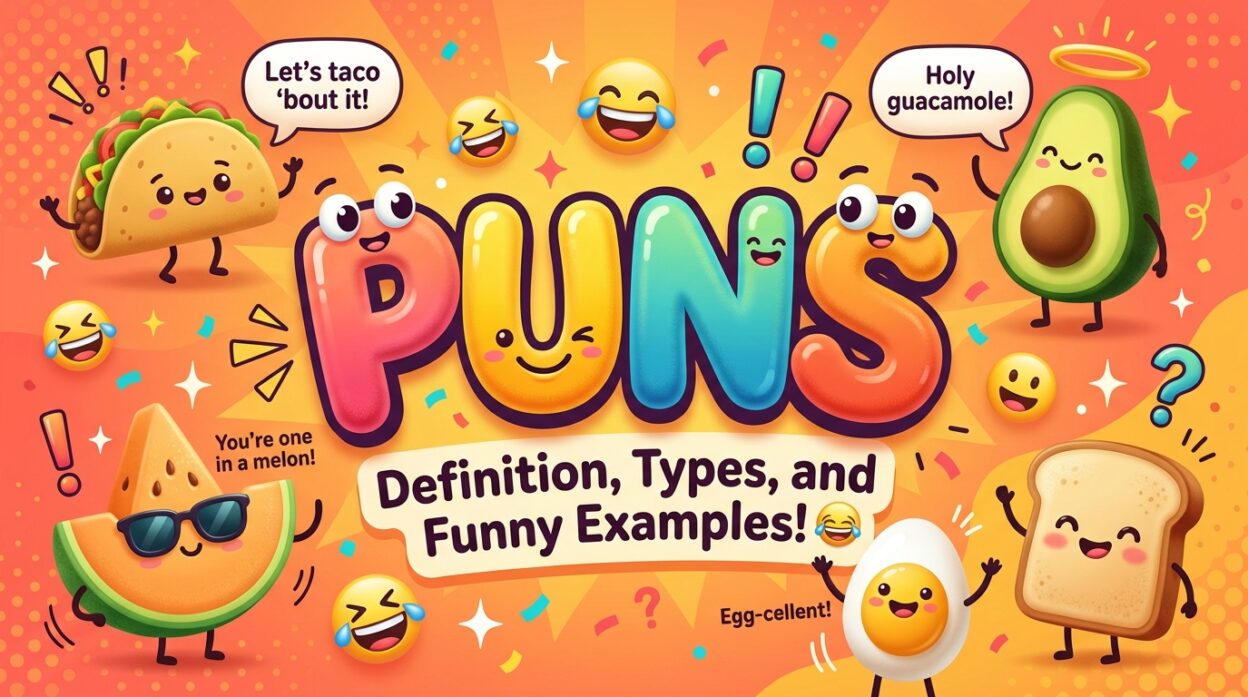
Have you ever heard a joke that made you laugh because one word had two different meanings? That’s the magic of a pun! 😄 The puns definition is simple: a pun is a form of wordplay that uses words with multiple meanings or words that sound alike to create humor, cleverness, or an unexpected twist.
Puns appear everywhere, from everyday conversations and social media captions to advertisements, greeting cards, and comedy shows. For example, someone might say, “I used to be a baker, but I couldn’t make enough dough.” The joke works because dough refers to both bread mixture and money. Once you recognize both meanings, the sentence becomes much funnier.
However, puns aren’t just about making people laugh. They can make writing more memorable, add personality to conversations, and help businesses create catchy slogans. In this guide, you’ll discover what puns mean, how they work, the different types of puns, and plenty of funny examples. You’ll also explore orange puns, tractor puns, pie puns, baseball puns, and fire puns. Get ready to discover the playful side of language! 🎯
What Is the Definition of a Pun? 🤔
A pun is a type of wordplay that uses a word’s multiple meanings or similarities between different words to create a humorous or clever effect. It encourages readers to recognize more than one interpretation of a phrase.
For example, consider this joke: “The bicycle couldn’t stand on its own because it was two-tired.” The expression sounds like “too tired,” while two refers to the bicycle’s two tires. That double meaning creates the punchline.
Puns can be silly, intelligent, sarcastic, or even romantic. Although people often associate them with jokes, writers also use them in poetry, novels, advertising, and everyday speech.
Here are some examples to make the meaning clear:
- I’m reading a book about anti-gravity. It’s impossible to put down. 📚
- The calendar’s days are numbered.
- A boiled egg every morning is hard to beat.
- The electrician was shocked by the news. ⚡
- The math teacher has too many problems.
- The gardener planted a light bulb and hoped to grow a power plant.
- The musician couldn’t find his keys, so he missed his opening note.
- The bakery’s business was rising, thanks to its excellent dough.
Each example connects two meanings or interpretations. That’s the central idea behind the definition of a pun: one expression creates an additional meaning that makes the wording more interesting.
What Does the Word Pun Mean? 📖
The word pun refers to a play on words. It describes an expression that deliberately uses similarities in sound, spelling, or meaning to create a clever effect.
Imagine a restaurant promoting its seafood with the slogan, “We have a whale of a time serving you.” The phrase connects a familiar expression with an animal associated with the sea. This makes the message more memorable and appropriate for the business.
The exact origin of the English word pun is uncertain, but its modern meaning is well established. A pun typically relies on ambiguity, sound-alike words, or a surprising connection between ideas.
Consider these additional examples:
- The coffee shop owner was always brewing up new ideas. ☕
- The tailor was suited for the job.
- The dentist’s jokes were filling.
- The actor made a dramatic entrance.
- The photographer was framed for the crime.
- The baker kneaded a little encouragement.
Notice how each sentence communicates an ordinary idea while adding another layer of meaning. As a result, puns can make simple language feel creative and entertaining.
How Do Puns Work? 🧠
Puns work by encouraging your brain to recognize two possible meanings in the same expression. First, you understand the obvious meaning. Then, another interpretation becomes clear, creating a moment of surprise.
For instance, “I used to be a banker, but I lost interest.” At first, interest sounds like enthusiasm. However, it also refers to money earned on savings or investments. That second meaning transforms an ordinary statement into a joke.
The best puns usually connect both meanings naturally. If the connection feels forced, the joke might earn an eye roll instead of a laugh. Nevertheless, even a groan-worthy pun can be entertaining when the timing is right! 😂
Try these examples:
- The bicycle shop was going downhill.
- I couldn’t remember how to throw a boomerang, but eventually it came back to me.
- The orchestra enjoyed a string of successful performances. 🎻
- The construction worker had a concrete plan.
- The shoe factory encouraged some sole-searching.
- The chef had a lot on his plate.
- The comedian made a cutting remark with a sharp delivery.
To recognize a pun, ask yourself whether a word has another meaning or sounds like a different word. If the second interpretation creates a clever twist, you’ve probably found one.
The Main Types of Puns 🎭
Not every pun works in the same way. Some rely on words with multiple meanings, while others use similar sounds or spelling to create a joke. Understanding these differences can help you appreciate wordplay and write more effective jokes.
Here are the main types you’ll encounter in everyday conversations, books, and comedy.
1. Homophonic Puns 🔊
Homophonic puns use words that sound alike but have different meanings or spellings. They work especially well when spoken aloud because the listener hears one sound and recognizes another possible meaning.
Examples include:
- The knight knew he had to fight for what was right.
- I wanted to buy banana shoes, but they kept splitting.
- The farmer was outstanding in his field.
- I couldn’t bear to leave the wildlife sanctuary. 🐻
- The musician knew the right note to write.
These jokes rely on pronunciation, so some may work better in conversation than in written form.
2. Homographic Puns ✍️
Homographic puns use words that share the same spelling but have different meanings. Depending on the word, the pronunciations may also differ.
For example, “The wind was too strong to wind the sail.” The first wind refers to moving air, while the second means to twist or turn something.
More examples include:
- The bass player caught a bass while fishing.
- The farmer decided to sow seeds after watching the sow.
- The experienced tailor could sew while watching the show.
- The dove flew away as the bride dove into the crowd.
- The present was a present nobody expected. 🎁
These puns reward readers who pay attention to context and the different meanings a word can carry.
3. Homonymic Puns 🎯
Homonymic puns use words that share a spelling, a pronunciation, or both while carrying different meanings. The humor comes from switching between those meanings.
For example, “The bank was beside the river, but it still had plenty of interest.” The word bank can refer to a financial institution or the land beside a river. Meanwhile, interest adds another possible interpretation.
Here are more examples:
- The baseball player went to the bank to check his balance.
- The fisherman couldn’t find the right line.
- The bookkeeper enjoyed counting on people.
- The gardener’s career was growing.
- The runner found himself in a difficult race against time.
Although these categories sometimes overlap, they all demonstrate how words can carry more than one meaning.
4. Compound Puns 🧩
A compound pun combines two or more wordplay ideas in one joke. These puns can be especially entertaining because the punchline contains multiple layers.
Examples include:
- The bakery’s new employee rose to the occasion because he kneaded the dough.
- The electrician found his job enlightening, even when the work was shocking. ⚡
- The gardener had deep roots in the community and a growing reputation.
- The fisherman knew business was going swimmingly, but he couldn’t scale it up.
- The musician was in tune with the audience and struck the right chord.
Compound puns can be clever, but moderation helps. Too many wordplay twists in one sentence can make the joke difficult to understand.
Funny Puns That Make You Groan and Giggle 😂
Funny puns turn ordinary situations into unexpected jokes. They work well in casual conversations, family gatherings, school activities, and social media posts. Sometimes the humor is clever; other times, it’s deliberately cheesy.
The secret is to make the punchline easy to understand. You don’t need complicated vocabulary or an elaborate setup to make a pun enjoyable.
Try these funny examples:
- I stayed up all night wondering where the sun went. Then it dawned on me. 🌞
- The scarecrow won an award because he was outstanding in his field.
- I used to hate facial hair, but then it grew on me.
- The calendar applied for a job because its days were numbered.
- The skeleton didn’t fight because he didn’t have the guts.
- The baker quit because he couldn’t make enough dough.
- The clock was hungry, so it went back four seconds.
- I wanted to learn about electricity, but the subject had too many current issues.
- The comedian opened a bakery because he wanted to make people crumble.
- The gardener’s favorite music had great roots.
Funny puns are also useful when creating themed content. For example, fruit jokes can brighten a food caption, while machinery jokes can entertain farming enthusiasts.
Clever Puns for People Who Love Wordplay 🧠
Clever puns are slightly more subtle than straightforward jokes. Instead of relying entirely on a silly punchline, they connect words and ideas in a way that makes the reader pause and think.
These puns are useful in writing, presentations, witty conversations, and headlines. They can also make a short message sound more original without adding unnecessary words.
Here are some clever examples:
- The mathematician’s marriage was a success because they had a common denominator.
- The gardener was promoted because she had cultivated excellent relationships.
- The musician couldn’t find his place in the orchestra, so he took a stand.
- The lawyer’s argument had a strong case.
- The novelist’s career was full of interesting chapters.
- The astronomer needed space after a long day.
- The scientist had a positive reaction to the experiment.
- The detective always followed the clues and stayed on the right track.
- The carpenter handled pressure because he had built a solid foundation.
- The editor cut to the point.
Clever wordplay often works best when the audience already understands the expression being used. As a result, a familiar phrase with a surprising twist can be more effective than an obscure reference.
Short Puns for Captions and Conversations 📱
Short puns are perfect when you want to make a quick impression. They fit naturally into text messages, Instagram captions, greeting cards, and casual conversations because they deliver the joke without requiring a long explanation.
They’re also useful when you want a caption that feels playful rather than overly polished. A few carefully chosen words can turn an ordinary photo into something memorable.
Here are some short puns to try:
- I’m kind of a big dill. 🥒
- You make miso happy.
- Don’t worry, be frappe.
- I’m feeling grape today. 🍇
- Let’s taco ’bout it.
- You’re tea-riffic. ☕
- Life is gouda.
- I’m nacho average friend.
- Orange you glad we’re friends?
- I loaf you.
- That’s how I roll.
- I’m on a seafood diet. I see food, and I eat it.
- You butter believe it.
- Stay pawsitive.
- I’m having a brew-tiful day.
Short puns are especially effective when the wordplay matches the situation. For example, a coffee pun works well with a café photo, while a food pun can add personality to a recipe post.
Puns for Social Media and Instagram Captions ✨
Social media captions often need to be short, catchy, and easy to understand. Puns meet those needs by combining humor with a memorable phrase. They’re particularly useful for food photos, travel posts, seasonal celebrations, and pictures with friends.
However, the strongest caption isn’t necessarily the most complicated one. Instead, choose a pun that relates directly to the image or message you want to share.
Try these caption ideas:
- Orange you happy to see me? 🍊
- Having a wheelie good time.
- I’m just here for the plot twists.
- Feeling grate and looking sharp. 🧀
- You can’t espresso how much this means to me.
- A little dirt never hurt.
- Seas the day. 🌊
- I’m on cloud wine.
- Life is better when we’re together.
- Just rolling with it.
- Current mood: positively charged.
- Looking sharp and feeling pointed.
- Donut worry about a thing. 🍩
- I’m pawsitively loving this moment.
- Having a reel good day.
For better results, match your caption to your audience. A playful pun might work perfectly for a personal post, while a business account may benefit from wordplay that reflects its products or services.
Romantic and Cute Puns for Everyday Use ❤️
Puns can also make affectionate messages feel more personal. Instead of relying on a standard compliment, you can use wordplay to express interest in a lighthearted way.
Cute puns are especially useful for greeting cards, anniversary messages, playful texts, and notes to someone you care about. Keep the tone natural, though. A pun should make the message warmer, not distract from what you genuinely want to say.
Here are a few sweet examples:
- We make a great pear. 🍐
- You make my heart skip a beet.
- I’m so fondue of you.
- You’re the berry best.
- I love you a latte. ☕
- We were mint to be.
- You make life butter.
- You’re one in a melon. 🍉
- I’m stuck on you like glue.
- You have a pizza my heart.
- You make my heart soar.
- We’re two peas in a pod.
- I love you from my head tomatoes.
- You’re tea-lightful.
- We have a grate relationship.
The best romantic pun reflects the relationship and the recipient’s sense of humor. A simple, personalized line can be more meaningful than an elaborate joke copied from somewhere else.
Food Puns That Turn Everyday Words Into Jokes 🍕
Food is one of the easiest subjects for puns because many food names resemble familiar expressions. That’s why food wordplay appears on restaurant menus, bakery signs, cooking blogs, and social media captions.
These jokes can make a menu more memorable or add humor to a recipe post. They also work well for party invitations and food-themed celebrations.
Here are some delicious examples:
- You’re the apple of my pie.
- Lettuce celebrate! 🥬
- I love you berry much.
- That’s nacho problem.
- Donut give up on your dreams.
- I’m feeling souper today.
- You make miso happy.
- Life is what you bake it.
- I’m on a roll.
- We make a great pear.
- Don’t go bacon my heart. 🥓
- You’re one tough cookie.
- It’s nacho average party.
- Olive you so much.
- Whisking you a wonderful day.
Food wordplay works particularly well when the pun matches the dish or occasion. A dessert joke, for instance, makes a natural addition to a baking post or birthday invitation.
Orange Puns for Bright and Cheery Wordplay 🍊
Orange puns combine fruit vocabulary with expressions about happiness, color, and everyday life. They’re especially useful for fruit-themed captions, kitchen décor, lunchbox notes, and cheerful messages.
The trick is to choose familiar phrases that naturally connect to the fruit. When the wording feels effortless, the joke becomes easier to remember.
Here are some orange-inspired examples:
- Orange you glad we’re friends?
- You’re one in a peel-ion.
- I find you very a-peel-ing.
- Orange you happy it’s a sunny day?
- Squeeze the day! 🍊
- You’re the zest.
- Life is better when it’s fresh-squeezed.
- I’m just trying to concentrate.
- Keep calm and stay juicy.
- You’ve got a zest for life.
- This friendship is simply un-peel-ievable.
- Let’s make today citrus-ly amazing.
- I’m feeling zest in class.
- You brighten my day from the inside out.
- It’s going to be a pulp-ular day.
If you need more fruit-themed humor for captions or jokes, check out orange puns for additional ideas and inspiration. These playful expressions are easy to adapt to photos, greeting cards, and food-related content.
Tractor Puns for Farm Humor 🚜
Tractor puns bring together farming terms, machinery, and familiar expressions. They can work well for agricultural social media accounts, farm-themed parties, country-life captions, and lighthearted messages for people who enjoy rural humor.
Some jokes focus on engines and equipment, while others play with words such as field, plow, and wheely. Either way, a clear connection makes the punchline stronger.
Here are some tractor-themed puns:
- I’m having a wheely good day on the farm.
- You tractor my attention wherever you go.
- Let’s plow through the problems together.
- I’m outstanding in my field. 🌾
- This farm life is growing on me.
- Keep calm and carry on farming.
- I’m geared up for a productive day.
- There’s no stopping this crop of ideas.
- Farming is a wheel-y rewarding job.
- I dig your sense of humor.
- We’re on the road to a bumper crop.
- My farming plans are really taking root.
- It’s time to turn over a new leaf.
- This tractor is a real driving force.
These lines are suitable for farm photos, tractor enthusiasts, and country-themed posts. You can also personalize them with the type of machinery or crops featured in your content.
For more machinery-themed wordplay, explore tractor puns to find additional ideas for farm captions, agricultural jokes, and country humor.
Pie Puns for Sweet and Funny Moments 🥧
Pie puns are a natural fit for baking, holidays, dessert menus, and family celebrations. They combine familiar food expressions with words about affection, sharing, and having a good time.
For the best effect, keep the message short and connect the wordplay to the occasion. A pie pun on a bakery sign may attract attention, while one on a birthday card can add a little warmth.
Try these examples:
- You are the apple of my pie.
- Pie love you forever.
- You’re a cutie pie. ❤️
- Easy as pie.
- Pie am so glad we’re friends.
- You’re looking cherry sweet.
- Give them something to talk a-pie.
- I only have pies for you.
- Life is short, so eat more pie.
- You’re the sweetest slice of my life.
- I crust you completely.
- This party is going to be pie-fect.
- I like big pies and I cannot lie.
- You’re the best thing since pumpkin pie.
These puns are especially useful for dessert lovers, baking enthusiasts, and anyone creating seasonal food content. For even more dessert-themed wordplay, browse pie puns for ideas that suit birthday cards, baking photos, and sweet captions.
Baseball Puns for Sports Fans ⚾
Baseball puns turn familiar sporting terms into clever jokes. Words such as pitch, base, hit, and catch offer plenty of opportunities for double meanings, making this type of wordplay ideal for game-day captions, team celebrations, and friendly sports banter.
You don’t need to be a professional player to appreciate these jokes. In fact, the best baseball puns often work for casual fans because they connect the sport with everyday situations.
Here are some baseball-inspired lines:
- You’re a real catch.
- I’m just trying to cover all the bases.
- That idea was a home run. 🏆
- Let’s hit it out of the park.
- I’m pitching in whenever you need me.
- You stole my heart like a base.
- This team has a winning streak of good ideas.
- I’m not playing around; you’re a grand slam.
- Our friendship is a major league deal.
- I have a good feeling about this pitch.
- You really knocked it out of the park.
- I’m rooting for you, no matter the score.
- Let’s catch up after the game.
- You make every day a home run.
- We make a great team, no strikes attached.
Baseball puns are a fun way to celebrate a win, encourage a teammate, or add personality to a sports-related post. For more sport-specific wordplay, explore baseball puns for game-day captions, team jokes, and baseball-themed messages.
Fire Puns for Hot Wordplay 🔥
Fire puns rely on expressions associated with heat, flames, sparks, and burning passion. They’re useful for playful compliments, summer captions, dramatic announcements, and jokes about someone doing an excellent job.
Some fire puns are literal, while others use heat as a metaphor for excitement or success. A well-chosen phrase can make a message feel energetic without becoming overcomplicated.
Here are some fiery examples:
- You’re absolutely on fire.
- That performance was lit. 🔥
- Our friendship sparks joy.
- Things are heating up.
- You bring the heat wherever you go.
- That idea is smoking hot.
- I’m fired up for the weekend.
- Let’s ignite some good memories.
- You’re a real flame of inspiration.
- This party is going to be fire.
- I have a burning question.
- You’re too hot to handle.
- I’m trying to keep my cool around you.
- The competition is getting heated.
- You light up every room you enter.
Use these lines when you want to express excitement, admiration, or enthusiasm. For more heat-inspired wordplay, check out fire puns for funny captions, playful compliments, and jokes that bring a little extra spark.
How to Create Your Own Puns ✍️
Creating an original pun becomes easier when you start with a familiar word and explore its possible meanings. You don’t need to be a professional comedian. Instead, focus on simple connections that your audience can understand quickly.
Use the following process to develop your own wordplay:
1. Choose a topic. Start with something familiar, such as food, sports, animals, school, or work.
2. Find words with multiple meanings. For example, pitch can refer to a sports throw, a musical tone, or a sales presentation.
3. Look for similar sounds. Words that sound alike can create opportunities for surprising connections.
4. Start with a familiar expression. Phrases such as “hit the road” or “a piece of cake” offer useful starting points.
5. Add an unexpected twist. Change one word or connect the expression to your topic.
6. Read the result aloud. If the pun sounds natural and the meaning is easy to understand, you’re on the right track.
For example, suppose your topic is gardening. You might start with the expression “growing on me” and turn it into a joke about a plant that becomes a favorite. Alternatively, you could use root to connect gardening with family history or a strong foundation.
Remember that not every pun will be hilarious. Some will be clever, some will be silly, and others will be so corny that they become funny all over again. Experiment with different wording until you find something that feels natural.
Why Are Puns Popular in Writing and Everyday Conversation? 💬
Puns remain popular because they make language interactive. Instead of simply receiving information, readers get to recognize a hidden meaning or solve a tiny verbal puzzle.
They can also make content easier to remember. A catchy slogan, playful headline, or clever caption often stands out more than a plain statement. Businesses use this effect in advertising, while writers may include puns to add personality to a character or scene.
Here are a few reasons people enjoy wordplay:
- Humor: Puns create lighthearted moments in conversations.
- Memorability: Clever phrasing can make messages easier to recall.
- Creativity: Wordplay encourages people to explore language in new ways.
- Engagement: A good pun can encourage readers to comment or share.
- Versatility: Puns work in captions, greeting cards, advertisements, speeches, and stories.
- Connection: Shared humor can help people feel more comfortable with one another.
However, context matters. A pun that works among friends might not fit a serious business email or a sensitive conversation. Choose wordplay that matches the audience, purpose, and tone.
Common Mistakes to Avoid When Using Puns 🚦
Puns are simple in principle, but some approaches make them less effective. The goal is to create a clever connection, not to force a second meaning into every sentence.
Keep these common mistakes in mind when writing your own:
- Forcing the wordplay: If the sentence sounds unnatural, rewrite it.
- Making the joke too complicated: Readers should recognize the second meaning without a long explanation.
- Repeating familiar jokes too often: Classic puns have their place, but original variations can make your content stand out.
- Ignoring the audience: A technical pun may confuse readers who aren’t familiar with the subject.
- Overusing puns: Too much wordplay can make an article feel repetitive.
- Choosing the wrong moment: Humor works best when it fits the situation.
- Confusing cleverness with clarity: The main message should remain understandable even when the pun adds another layer.
For example, a bakery can use “Life is what you bake it” because the phrase is familiar and the connection is obvious. A completely unrelated food reference might feel confusing instead.
Ultimately, effective wordplay balances clarity, surprise, and relevance. When all three work together, even a short pun can leave a lasting impression.
Frequently Asked Questions About Puns ❓
1. What is the simple definition of a pun?
A pun is a play on words that uses multiple meanings or similar-sounding words to create humor or a clever effect. For example, “The calendar’s days are numbered” plays on the idea that a calendar contains numbered dates and that someone’s days may be limited.
2. What is an example of a pun?
An example is, “I used to be a baker, but I couldn’t make enough dough.” The word dough refers to both bread mixture and money, creating a humorous double meaning.
3. What are the main types of puns?
Common categories include homophonic puns, which use similar-sounding words; homographic puns, which use identically spelled words with different meanings; homonymic puns, which exploit words that share spelling or pronunciation; and compound puns, which combine multiple wordplay techniques.
4. Why do people use puns?
People use puns to entertain, make messages memorable, add creativity to writing, and create playful connections in conversation. They’re also common in advertising, social media captions, greeting cards, and comedy.
5. Are puns and jokes the same thing?
Not exactly. A pun is a specific type of wordplay, while a joke is a broader form of humor. Some jokes rely on puns, but others use stories, exaggeration, irony, or unexpected situations.
6. Can puns be used in professional writing?
Yes. Puns can work in advertising headlines, product names, marketing campaigns, and informal business communications. However, they should suit the audience and purpose. Clear, direct language is usually preferable for formal or sensitive topics.
7. How can I make my own puns?
Start with a familiar topic, identify words with multiple meanings or similar sounds, and connect them to an expression your audience already knows. Then simplify the wording until the punchline feels natural and easy to understand.
8. Why are some puns considered bad jokes? 😂
Some puns rely on predictable wordplay, obvious connections, or awkward phrasing. People often call these jokes “corny” or “groan-worthy.” Nevertheless, their silliness can be part of the appeal, especially when shared with friends or family.
Conclusion: Understanding the Puns Definition 🎉
The puns definition describes a playful form of language that uses multiple meanings, similar sounds, or clever word associations to create humor and interest. From short captions and romantic messages to orange, tractor, pie, baseball, and fire puns, wordplay offers countless ways to make ordinary expressions more memorable.
Puns can entertain readers, strengthen creative writing, and add personality to everyday conversations. Moreover, creating your own puns is an excellent way to experiment with language and develop a sharper sense of humor. Start with a familiar word, explore its possible meanings, and look for an unexpected connection. 😄
Not every pun will make everyone laugh, and that’s part of the fun. Sometimes a clever line earns a big laugh; other times, it earns an affectionate groan. Either way, a little wordplay can make language more enjoyable.

Jake Mitchell is a humor writer and wordplay enthusiast who specializes in pickup lines, puns, jokes, and witty one-liners. He enjoys creating entertaining content that helps readers break the ice, spark conversations, and share a laugh. Through PickupStorm, Jake curates fun, creative, and engaging humor for readers who appreciate clever wordplay and lighthearted entertainment.